About
beat-geometry.com is a free educational tool for visualising rhythms using geometry. Like anything "created", it's not something entirely new:
- The rhythm circle is an old idea, actively used for at least a few decades by some music scholars and composers. The idea of using geometry to represent music has records going back to as far as the 13th century.
- The rhythm circle was widely popularised by the book The Geometry of Musical Rhythm by Godfried T. Toussaint.
- The online format isn't new either: rhythm-circle.com has existed since at least mid-2024.
What's actually new about the site comes down to just a few concepts:
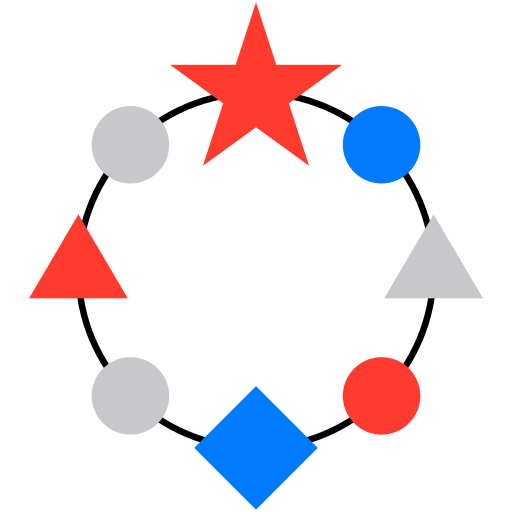
- It uses different geometric shapes for the beat "slots" to create a sense of hierarchy between positions. The Star and Diamond shapes are always used for the main "beats" (the "pulses", which are the ones we count BPM against). The Triangle represents the first subdivision on top of the pulse, and the Circle represents one extra subdivision on top of that. One example is sextuplet: we made the editorial choice of representing it as "two triplets", so we have the triangle dividing the space in half, and then circles that subdivide each half in 3 parts.
- By default, every beat already carries two types of sound: a "primary" one and a "secondary" one. This helps describe several rhythms that are distinguished by low versus high beats a bit more precisely, like the difference between the maceta and bacalhau strokes on the zabumba, the low and mid tones on the pandeiro, the Doum and Tek found in traditions from the Middle East, and so on.
- Several types of labels are available, like musician counts (1, e, +, a), Takadimi (Ta, Ka, Di, Mi) and Forrozeiro counts.
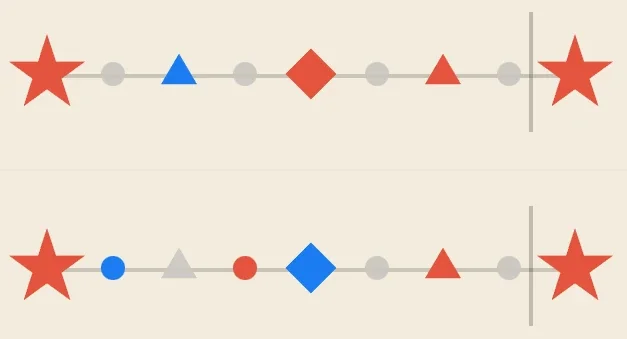
- The timeline view. Even though the view looks a lot like the music score we use in Western music, the way notes interact with taps between primary and secondary states, the proportionality between spacings when using different subdivision types, and the hierarchy of geometric shapes are all new (as far as I know!).
The motto that guides the site is this one:
All models are wrong, but some are useful — George Box
To balance the model's simplicity with its usefulness for teaching, the site makes several simplifications.
Here's a simple example: when we're talking about the basic Baião beat, the first note is generally expected to be muted, and the second one open. But if you, the user, switch to 2-state mode, use the Baião rhythmic cell and change the instrument to zabumba, you'll notice that both notes come out continuous ("open").
This is intentional, and it has everything to do with what beat-geometry.com tries — and doesn't try — to be.
What does beat-geometry.com try to be?
beat-geometry.com is a free educational tool for learning and teaching rhythms.
The site currently offers two different views:
- The circle view, used to visualise and build rhythms in sequence. When each circle finishes, the next one starts, and once they've all played, we go back to the first beat of the first circle. Each circle can have its own configuration for number of beats, number of subdivisions, instrument, note labels and more. The shapes, colours and geometry of the circle were designed to optimise learning and help users make interesting connections between different rhythms.
- The timeline view, built to visualise and construct small compositions with several different voices or instruments playing at once. This model sits much closer to traditional Western music notation, but we still use the same geometric shapes, colours and spacing to explain the intervals.Timeline view
I personally also like using it as a kind of "dynamic metronome", to practise musicality, but that's a secondary use.
What doesn't beat-geometry.com want to be?
- An accurate representation of musical loops. Music is far richer than these simplifications: even a single instrument carries a lot of timbral variation depending on how the musician handles it; the rhythm itself isn't perfectly precise or fixed either, and that human touch is what creates "swing".
 An iOS and Android app that represents real music much more faithfully across various musical styles is e-batuque: I've personally spent hours and hours studying with it, and I use it regularly in my Forró classes.
- A fully flexible model for representing new rhythms. The site focuses on the most common styles of global music, and combining pulse counts with subdivisions makes it easy to build rhythms in 2/4, 3/4, 4/4, 6/8 and 12/8 time signatures. Even though that sounds like a lot, there are plenty of other possibilities out there, like beats that divide the space into 5 or rhythmic cells with 7 pulses, for example.
 For more flexibility in the number of spaces, I'd recommend rhythm-circle.com.
 A music synthesiser. The idea is to teach and to learn. To make real music, consider other software like Ableton Live, or better still: get together with other musicians and bring your instruments into the room.
The Future
I like to joke that this site is my fourth job (more on my other three "jobs" in the next section). Because of that, my time to work on it is pretty limited, but I still have plenty of ideas for the future. Here are some of them, roughly in the order I expect to get to them, though none of it is guaranteed:
About the creator

Hi, my name is Márcio Ramos. I have two "identities" relevant to this site. Professionally, I'm a software engineer, and my main job today is as a Google employee. For inspiration and pleasure, I'm also a dancer and partner-dance teacher. Today I'm co-founder and teacher at a Forró school called Amarelo (@amarelozrh), and I recently started teaching Tango at another school called La Pantera (@la_pantera_zurich), both in Zurich (Switzerland).
The inspiration to build this site came from the intersection of these two identities. I started studying rhythms in depth, even without being a musician, because I wanted to live the rhythms more fully and become a better dancer. That study took me much further than I ever imagined: the diversity of rhythms around the world is incredible, and once you notice that diversity, your mind for dance and music is never quite the same again. At the same time, the similarities inspire me as a human being. Two connections that stuck with me were realising how strongly the beat of Brazilian Funk resembles the base beat of Salsa (Son Clave), and how similar the base beats of Milonga and Reggaeton (the Habanera) are. Far beyond labels like "elite" or "the masses", and beyond any concern about which side of a river or an imaginary line people happened to be born on, we often have far more in common with other humans than these small differences lead us to believe. As a software engineer, I also have the tools in hand to help popularise this knowledge through code.
The motivation that drives me to work on this site is to spread this kind of knowledge: I want a lot more people to feel that same magic I feel when I study rhythms. I want conversations with my fellow dance teachers to go further and dig deeper into more interesting topics than ever before. I want to keep learning from my DJ and musician friends, and to have a way of representing what they're telling me with at least some accuracy.
It also helps that I'm currently in a comfortable enough financial position to develop this site out of pure passion. I hope this site becomes a tool that helps popularise this knowledge for everyone. If you've found something on the site that needs fixing, have suggestions for the future, or just fancy sending a compliment, message me on Instagram: I'm @marrciovr over there.
Sources and Credits
No one does anything alone. Even though this site is built almost entirely by a single developer, several people have influenced it, directly or indirectly:
- My great friend Matheus Pereira was by far the person who contributed the most ideas (and criticism!) to this site. He's also the artist who drew all the instrument icons.
 The book The Geometry of Musical Rhythm by Godfried T. Toussaint completely changed the way I understand rhythms, and broadened my horizons to study more about different rhythmic traditions around the world. The YouTube channel Mathemusique served as good complementary material to the book.
 Several YouTube channels influenced me deeply. Many of them were aimed mainly at musicians (pianists, zabumba players, pandeiro players), but they still held very rich information for everyone. There are too many videos and channels to mention them all, but the main ones were the channels of David Bennett, Charly Sauret (especially this video), Rafael Beibi and Léo Rodrigues.
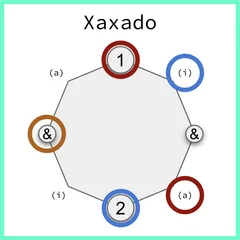 The base visualisations for the Forró family of rhythms come from this page, and as far as I know they were transcribed by a musician and dance teacher named Sérgio Viana, founder of a Forró school in Lausanne called Escola NoPé.
 Another page that opened my eyes to other rhythms from around the world was Handpan Dojo: even though the rhythms are demonstrated on the handpan, the notation is accurate. I'm also still learning a lot from the sources he himself pointed to, like this page (once I'm confident I've properly understood enough of these rhythms, I plan to bring them to the site as rhythmic cells).